BME 354 Multi-Chip IC Tester
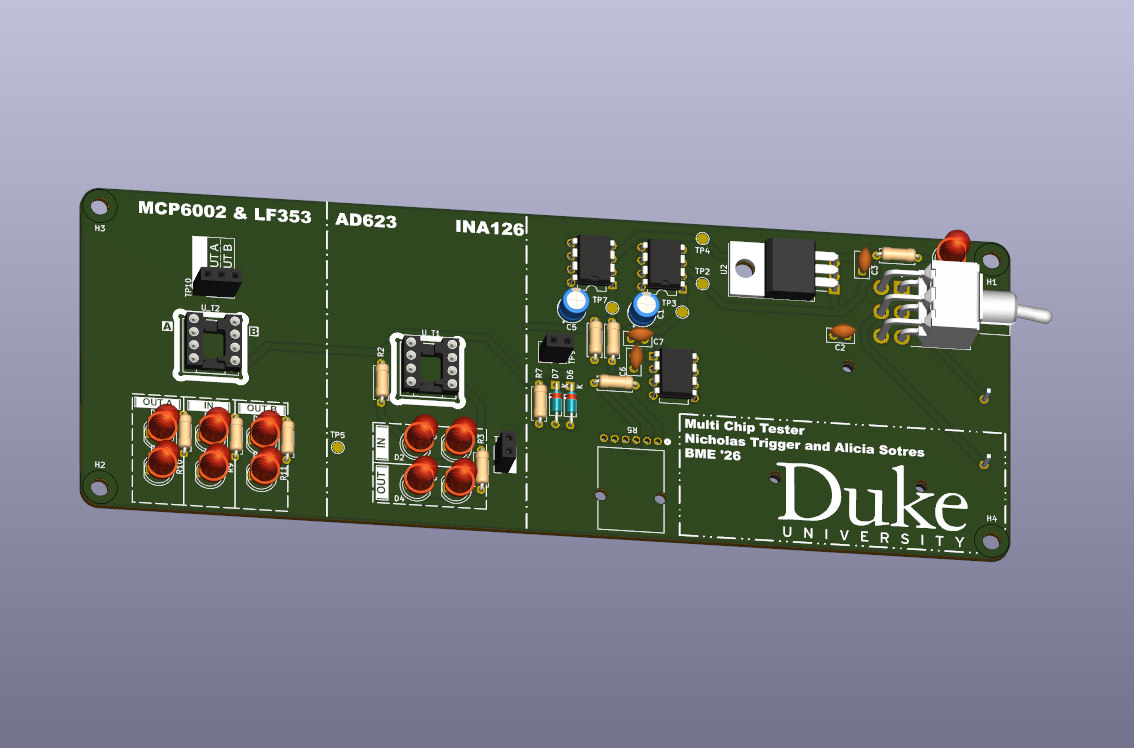
HardwareA custom KiCad PCB designed for BME 354 at Duke University that validates multiple integrated circuits in sequence — reducing bench setup time and providing a repeatable test fixture for analog IC verification.
View on GitHubOverview
The Multi-Chip IC Tester is a custom PCB designed for BME 354 (Biomedical Electronic Measurements) at Duke University. The board provides a single, repeatable test fixture for validating multiple analog integrated circuits in sequence — replacing the rat’s-nest of individual breadboard setups that would otherwise be required for each IC.
Problem
BME 354 lab work involves characterizing a suite of analog ICs — op-amps, comparators, and other linear devices. Testing each chip individually on a breadboard is time-consuming and prone to wiring errors that obscure whether a failure is in the chip or the setup. A dedicated PCB eliminates that ambiguity by providing a fixed, known-good test harness for every device under test.
PCB Design
Designed in KiCad. Key layout decisions:
| Feature | Detail |
|---|---|
| Multi-socket layout | DIP sockets for each target IC, wired to a shared test bus |
| Power rails | Decoupled ±V supply rails with bypass capacitors at each socket |
| Test points | Labeled probe pads at key nodes for oscilloscope or DMM access |
| Input/output headers | Pin headers for function generator input and scope output connections |
The board routes signal, power, and ground traces such that each IC slot is electrically independent — a failed device does not affect adjacent socket measurements.
Workflow
- Insert target IC into the appropriate DIP socket
- Connect bench supply to the power header and function generator to the input header
- Probe labeled test points with an oscilloscope or DMM
- Compare measured transfer characteristics against datasheet specs
- Swap to the next IC and repeat — no rewiring needed
Course Context
BME 354 covers analog measurement systems used in biomedical instrumentation: amplifiers, filters, ADCs, and signal conditioning. The ICs tested on this board feed directly into larger lab circuits — ECG amplifiers, photodetector front-ends, and similar physiological measurement chains. Having a fast, reliable IC verification step early in the lab workflow prevents hours of debugging downstream.